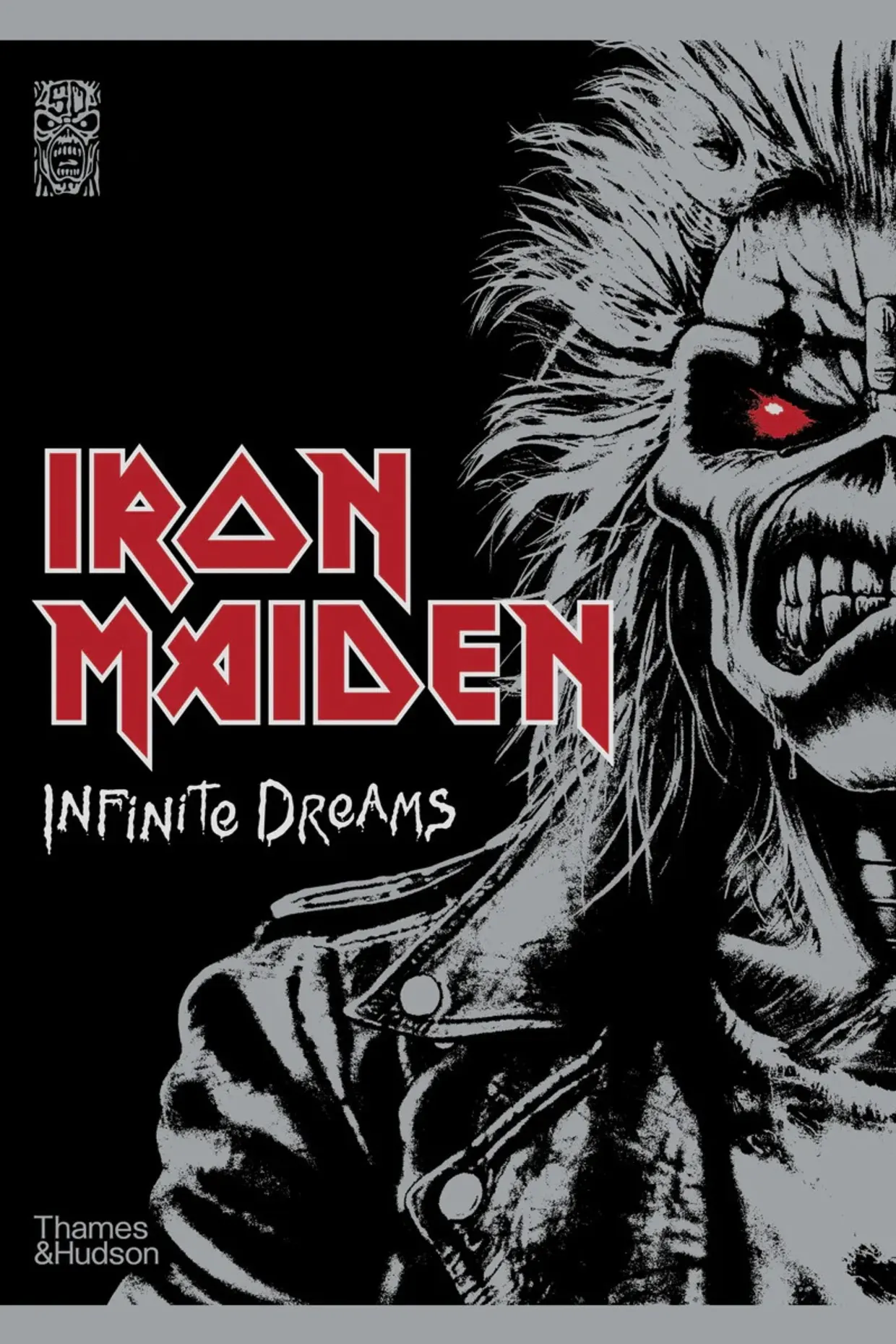
Infinite Dreams documents the as-of-now complete history of Iron Maiden from 1975-2025. Fifty years is a lot of time and this is a lot of book. It measures 9.9 by 12.9 inches and is 1.4 inches thick with 352 pages. It’s hardcover with thick and glossy pages. I couldn’t find a weight listed, but as you can imagine from the dimensions, this is a heavy book for a heavy band.
With 1,024 color illustrations, Infinite Dreams earns its subtitle of The Official Visual History. Given Maiden’s extensive history, gathering random photos, giving them a brief caption, organizing them by decade, slapping the Iron Maiden logo on the collection, and releasing it as some sort of official history would be relatively easy. However, “We owe people a great performance,” promises Steve Harris—founding member, bassist, and the only member to appear on every Iron Maiden record—in the foreword (7).
There are numerous books about Iron Maiden, but only a small percentage have the band’s cooperation and approval. Because of the band’s involvement, Infinite Dreams accesses their personal collection of photographs and artifacts. Also, rather than drawing only from previously published quotes, Infinite Dreams gives us new words and insights. In other words, this is a fresh take on an already well-covered topic.
Infinite Dreams contains four major sections, each covering a specific era that coincides with a bandmember’s first appearance, departure, and/or return (The formation of Iron Maiden and Paul Di’Anno’s tenure, Bruce Dickinson’s first voyage and Adrian Smith’s departure, Dickinson’s split and Blaze Bayley’s time with Maiden, and Dickinson’s second voyage along with McBrain’s retirement). Although fans have different entry points and favorite eras of Iron Maiden, you can find “your” Iron Maiden somewhere in this book.
The first section is “Burning Ambition 1975-1982” (8-83), and its subsections are “Smiler | The Soundhouse Tapes | Metal for Muthas | The Birth of Eddie | Iron Maiden | Reading Rock ’80 | KISS Tour | Killers | Di’Anno Departs.” Early histories of a band can be a slog because that band is still working out their sound and lineup, they have no money to make records and create stage shows, we must read about where they went to school in the fifth grade, they have bad haircuts in the photos—whatever. Infinite Dreams lays out Iron Maiden’s first years well by selectively choosing documentation that is both informative and engaging. Some of the photos and illustrations we see in this section, and the other three, include album and single artwork, instruments, stage setups, various members, newspaper headlines and articles, diary excerpts, live shots, business correspondence, account statements, and T-shirts.
The captions throughout the book are not just brief identifiers or credit attribution; some are extended and they deepen the overall narrative. In addition to the captions, there is plenty of standalone text. Though primarily a visual history, the book’s text complements its images and vice versa. It’s a book to look through and to read.
Something eye-catching from the first section is Paul Di’Anno’s leather jacket with the first official Iron Maiden T-shirt inside it (62). That someone somewhere thought to save or photograph these items is incredible. Sixteen pages later, there is a handwritten letter from Paul to Steve explaining his reservations about remaining in the band. He writes, “I can only suggest you find a new vocalist” (78). Although Infinite Dreams leans a bit towards the nebulous when covering personnel changes, it tends to be fair, balanced, and supportive when giving such accounts. Harris recalls, “Paul was an awkward character, but he had talent. It was a rollercoaster with him” (78). He reflects, “I always felt Paul didn’t feel he truly believed he had what it takes. I think he did.” (78).
“Where Eagles Dare 1982-1988” (84-207), the second section, contains the subheadings “The Number of the Beast | Piece of Mind | Powerslave | Rock in Rio | Live After Death | Somewhere in Time | Seventh Son of a Seventh Son.” Especially intriguing are the pages devoted to the Somewhere in Time record cover. There is a closeup of cyborg Eddie from the front of the album’s illustration. The other twenty percent of the page gives explanatory text of the album’s concept and creation (170). On the next page follows a preliminary black and white drawing and an early finished version in color underneath it. Artist Derek Riggs remembers that “The painting took two and a half months, but I had to stop for a week in the middle of it . . . I was sitting and starting at the picture, dreaming about where the people were going and what they were doing. You can go crazy” (170). The coverage continues with a two-page spread of the final color cover (front and back) with a key to the artwork’s many Easter eggs. Considerately, there is a vertical axis of letters and a horizontal axis of numbers to guide viewers so that when you see, for example, “G4 Over the bridge is a sign for Sand Dune Nightclub and Grill, another reference to the novel Dune, which inspired the 1983 song ‘To Tame a Land,’” you can locate it in less time than it took Riggs to complete the cover (172-173).
Somewhere around the midpoint, I realized that the book’s pages are sewn-in rather than glued-in, which makes for a longer-lasting book and for less page loss since you can open the book more fully.
Moving to the third section, “The Edge of Darkness” (208-257), the main topics are “Enter Janick | No Prayer for the Dying | Fear of the Dark | Enter Blaze | The X Factor | Virtual XI | Ed Hunter.” Inarguably, the most influential event of this era was Bruce’s Dickinson’s exit. Like the brief discussion of Adrian Smith leaving, Dickinson’s departure is acknowledged and quickly covered but neither explored nor explained. Dickinson offers, “My decision to leave: you could point back to lots of little things, none on which were really decisive” (223). The most concrete explanation is in the form of a pull quote: “I realized I had no idea how to be creative outside of the framework of Iron Maiden, and it terrified me. I was thinking, ‘I am in an institution, and I will die in this institution if I don’t do something about it. What can I do?’” (223).
The book is tougher on replacement vocalist Blaze Bayley. Nicko McBrain bluntly assesses, “The Blaze era of Maiden had many great moments, but there were many that weren’t . . . Blaze struggled” (249). Nicko says that “he loved the band; we loved him . . . I was sad towards the end because it’s difficult losing a comrade” (249). We are reminded several times that sales of both records with Blaze were slow (as they tended to be during that time for many metal bands not named Metallica). Still, Blaze made two albums with Maiden and is an important part of their history (songs from his records with Iron Maiden still pop up in live setlists after Bruce’s return). Infinite Dreams gives him his coverage, thought maybe not all of his credit.
How Infinite Dreams covers Iron Maiden’s various lead singers is important for several reasons. First, it’s interesting to see how the book handles major—and potentially touchy—events such as times of transition. Second, it proves that Infinite Dreams really does cover all significant aspects of the band’s history. Thirdly, it demonstrates how readers can trace whatever thread they find fascinating through the book whether the subject is lineup changes, artwork, stage design, touring, instruments, or Eddie the mascot.
“A Brave New World 2000- ” (258-343) is the final section. Its main topics are “Brave New World | Dance of Death | A Matter of Life and Death | Somewhere Back in Time | The Final Frontier | Maiden England Tour | The Book of Souls | Legacy of the Beast | Senjutsu | The Future Past Tour | Run for Your Lives.” With Smith and Dickinson back on board the Iron Maiden mothership, Maiden were fully equipped to zoom through the next quarter century. This chapter details both the studio albums and tours that followed. It concludes, as it should, with Nicko’s retirement from the band—there is a great two-page photo spread of him in the previous section (218-219)—and a discussion of their celebratory tour to mark fifty years.
In the backword—“It’s weird writing a foreword at the back of a book. Is that a backword then?”—Bruce admits that as to when Iron Maiden will end “even I can’t answer that one,” but, he assures us, “yes, the tale will go on and on” (345).
The book closes with a few additional apparatuses: a two-page touring milestones/history, a two-page sources of illustrations, a two-page index, and the requisite acknowledgements page.
Both comprehensive and cohesive, Infinite Dreams is a fun, brilliant gallop through five decades, and it sets an example of what a superlative rock book can be.