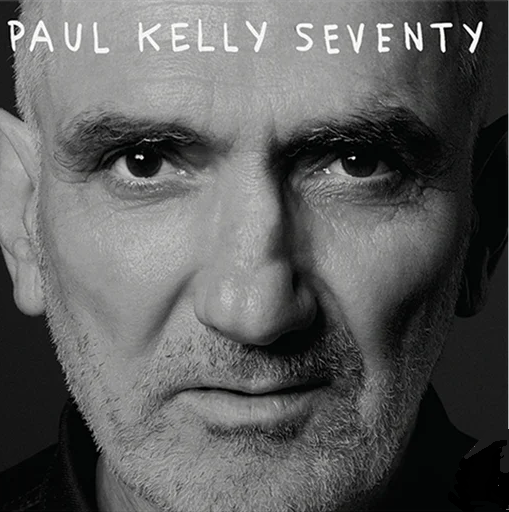
It’s the kind of milestone only a handful of songwriters ever reach. Paul Kelly turns seventy, celebrates fifty years in the business and releases what stands as his thirtieth studio album, Seventy. Half a century of writing, three decades of records, and a lifetime spent on the road — yet somehow, Kelly still sounds like he’s just getting started and has never lost that wonder of staring life in the face and chronicling it, that started him out in the first place. He’s always been the chronicler of everyday Australian life, a poet in denim and boots, blending sharp observation with melody. In a global sense, he’s our Springsteen or Dylan: a songwriter who captures the spirit of a place, its people and their struggles, with warmth, honesty, and grit.
Kelly’s never been about rock and roll excess, he’s all about connection — he’s the journeyman, the troubadour, the guy who always finds something that will take your ear and make you tap your feet and make you think. Seventy finds him looking age and mortality squarely in the eye, with the same calm defiance he’s always had but just that little more insight, picking up more nuances than the younger man. There’s a rock-solid rhythm to his reflection — no self-pity, no sentimental gloss, just lived experience squeezed out and turned into song. Tracks like The Body Keeps the Score and I’m Not Afraid of the Dark feel like barroom confessions from someone who has seen it all but still has stories left to tell, or told it all but revels in the detail that is added with each telling. And the fact that he’s now filling arenas in his seventies says everything — he’s not just still here, he’s at the peak of his powers.
As always, Kelly’s lyrical craftsmanship shines. Every word earns its place. His gift has always been for small details that speak volumes — a letter not sent, a memory triggered by a song, the weight of time in a lover’s voice. On Seventy, those recurring themes of love, regret, and reflection are distilled with elegant penmanship. He revisits ghosts from earlier songs and reconnects threads that run through decades of writing. There’s a quiet, yet defiant continuity here — the sense that Kelly’s life and catalogue are intertwined, each album a chapter in a long, unfolding novel about growing up, messing up, growing old, and never, ever giving up.
It’s fitting that his face now gazes down from the mural on the side of The Espy in St Kilda — a permanent reminder that Kelly isn’t just a musician, but part of Australia’s cultural fabric. That mural feels symbolic of his music: rooted in place, layered with history, and weathered yet still glorious. The same man who once filled the pubs now commands arenas, yet his songs remain as intimate as ever. That’s the trick, if there is one — the bigger the venues, the smaller the stories feel, the more personal they get. It’s the mark of a true storyteller when you transcend fads and phases and speak honest eternal truths that resonate.
A couple of songs stand out as future classics in a catalogue already bursting with them. The Body Keeps the Score is a slow-burning reflection on how time leaves its fingerprints on us all — a song that pairs delicate guitar lines with a lyric that could’ve been carved into old wood. It’s about facing what we carry, the bruises and blessings alike. Rita Wrote a Letter feels like vintage Kelly: narrative, emotional, and cinematic. The story could sit comfortably alongside To Her Door or How to Make Gravy, yet it’s written from an older man’s vantage point — reflective, forgiving, and rich with perspective. Both songs show how Kelly has matured without losing his instinct for melody or emotional truth.
Elsewhere, Made for Me glows with tenderness — a simple, heart-first ballad that recalls his early acoustic work but with the depth of a lifetime behind it. Little Fires carries a low, bluesy pulse and a quietly defiant message about keeping the flame alive, both in art and in love. And Tell Us a Story (Part 2) closes the album in cinematic fashion, looping back to its opening theme with warmth and nostalgia, as if Kelly were signing his name at the bottom of a long letter to us all. Together, these songs showcase his ability to shift between modes — storyteller, philosopher, and romantic — often within the same breath.
There’s plenty of gratitude and real curiosity running through Seventy. Kelly seems completely aware of where he stands — still making relevant, reverberating art at seventy years old, when most would be long retired and sat on the porch playing the Blues. Equally there’s no attempt to reinvent the wheel here, and thankfully no chasing trends. Instead, Kelly digs deeper into what he’s always done best: crafting stories that mean something. With so many of his songs looking back — to old characters, old loves, old wounds — one wonders where he heads next. After fifty years of bus rides and backstage rooms, does he venture into new sonic territory, or does he keep refining the timeless sounds that got him to this very point in time? My money isn’t on a Rap album or a dabbling with Heavy Metal, though both would be kind of weirdly wonderful…
In the end, Seventy isn’t just the latest Paul Kelly album — it’s a milestone. It’s the sound of a songwriter at peace with his past but still with feet itchy enough to drive him forward. Kelly’s songs remain rich, grounded, and unmistakably his own. Few artists manage to grow old without losing their spark; Kelly has managed it by keeping his kindling dry and staying true to himself. He’s still the storyteller constantly on the road, still shining a light on the ordinary and turning it into the remarkable, and that is the art of the man. Kelly is a true original and a valued national treasure. I’ve seen Paul play many times over the years and you always feel like you’re visiting an old friend after an absence of years, hanging out for new tales. Best of all Kelly is an artist who makes you feel truly at home.