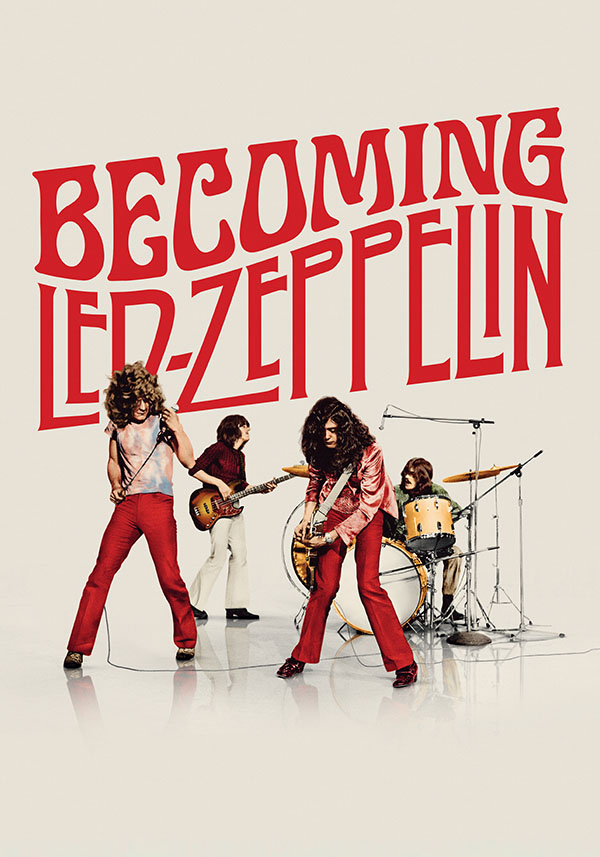
Becoming Led Zeppelin opens with the sound of “Good Times Bad Times” backed by a video of Led Zeppelin playing live. Intertwined are black and white clips of wartime footage, presumably World War II since there appears, for example, a newspaper frontpage dated May 1945. While few would describe Zeppelin as a World War II band, all four members were born in the 1940s. Led Zeppelin rose from the ashes and shadows of post-war conditions. Page explains that “at the end of the second World War, there was this great feeling of hope towards the future.” Perhaps this explains the focus on both hardship and optimism in their music.
This opening sequence lays out the documentary’s strategy: Have the band members explain Led Zeppelin in their own words, let the music speak for itself, and fill in some of the historical context with related images and sound. Fulfilling its title, Becoming Led Zeppelin begins prior to the formation of the band. After contextualizing the band within the post-WWII British landscape, we learn about the births of Jimmy Page, Robert Plant, John Paul Jones, and John Bonham. While hearing about their parents and seeing their baby pictures or video of Robert Plant’s school parade will interest hardcore fans, it’s difficult to imagine these origin stories bringing in many new ones (in terms of video, Led Zeppelin is the place to begin). More fascinating is listening to the members of Zeppelin talk about their influences and then seeing and hearing substantial clips of performers such as the Johnny Burnette Trio, Lonnie Donegan, Gene Krupa, Johnny Kidd and the Pirates, Carter-Lewis and the Southerners, Sonny Boy Williamson, Perry Foster, James Brown and His Famous Flames, Shirley Bassey, Donovan and Lulu. A notable segment is Little Richard playing “Long Tall Sally” live while standing up with one leg cocked over the piano’s top.
The interviewing rotates among Page, Jones, Plant, all of whom sat for new interviews specifically for this documentary, and the deceased Bonham via an audio interview (“This interview is heard here for the first time,” claims the documentary). Memorable tidbits include Jones’ father dismissing bass as a “novelty instrument.” “Get yourself a saxophone; you’ll always work,” Jones recalls his father advising. Jones became the organist and choirmaster for St. Aidens Church at 14. “I just improvised everything,” he confesses. Rev. Gordon Bates offered him the job. Jones describes him as “a really cool priest.” Two years later, “I left school when I was 16. I failed most of my exams because I’d been playing all night in some club the night before my O levels,” Jones explains. Plant details his musical influences. “Sonny Boy was almost everything that’s become my whole, entire musical bloodstream,” says Plant. “But in my own hometown, I had my own hero and it was Perry Foster.” Later, he describes the “time we were running out of fuel and I had to siphon gasoline from another car, and I was caught by the police in the middle of the night sucking a piece of rubber into a can and him [Bonham] sitting in the back shivering.” No wonder Plant recalls, Pat, Bonham’s wife, warning him “Don’t you dare play with that Planty. He’s a complete disaster.” Awed by an abundance of silverware on a flight with Bonham, Plant recollects that “Stuff that we would normally have stolen was there in profusion.”
Ever the keeper of Zeppelin’s flame, Page, unsurprisingly, focuses mostly on the development of the music. He produces a small datebook documenting his session work with the Rolling Stones, David Bowie, Petula Clark, the Kinks, the Who, and Donovan. He also worked on the film To Sir, with Love. Besides ditching school and helming the church organ, Jones played sessions as well. The two played together on the “Goldfinger” session at Abbey Road with Shirley Bassey performing vocals, Page on guitar, and Jones on bass. Along the way, Page and Jones absorbed loads of information about production and engineering, especially from Mickie Most. Jones asked Mickie Most if he needed an arranger—“I hadn’t really done that before.” Most accepted the offer. Jones remembers him driving in his Yellow Rolls-Royce to Jones’ place and dropping off an acetate with the instructions “You know what we want. It’s Friday.”
Page recalls a pivotal moment from a palm reading in L.A. The reader predicted, “You’re gonna be making a decision very soon, which is gonna change your life.” At that time, page was playing with the Yardbirds. Then, “A meeting happened like two or three days after the palmist where the rest of the group said, ‘That’s it. We wanna fold.’” Page immediately decided to form his own group. He asked Yardbirds manager Peter Grant to track down Terry Reid for vocalist. Reid had just signed a solo deal but suggested Plant who was singing for Obs-Tweedle. Page and Plant worked on a cover of “Babe I’m Gonna Leave You.” Of this first collaboration, Plant reflects, “We knew something was in the air.” Countering Page’s suggestion for a drummer, Plant convinced Bonham to join the lineup. Jones’ wife read Page was putting together a band and insisted Jones give him a call. The circle was now complete. They four played together for the first time on “Train Kept A-Rollin’.” Jones remembers the “The room just exploded.”
The documentary continues forward to the making of Led Zeppelin I. “Good Times Bad Times” plays while a camera looks down on them creating music in the studio, combined with footage of the workings of the studio behind the control boards, and images, video, and newspaper headlines about then-current topics such as soldiers shooting students in Mexico City, the 1968 Olympics Black Power salute, a Northern Ireland civil rights march, the Biafran War in Nigeria, the Vietnam War, Apollo 7, and Hair. Footage of Page playing “Black Mountain Side” follows.
A proud Plant declares that “Jimmy and John Paul were really at the top of their game. They’d played on so many diverse pieces of music that there was nowhere that they couldn’t comfortably find themselves going to. So that gave us a whole magnificent bunch of colors to play with.” Summarizing the complex balance of ingredients that makes Led Zeppelin unique, Jones concludes that “Zeppelin always had completely different influences. We all listened to different things . . . Led Zeppelin was in the area in the middle, in between us all.”
Applying his studio expertise, Page produced Led Zeppelin I. The band financed the album themselves and then shopped it around, playing it for Jerry Wexler at Atlantic Records and receiving a record deal. Realizing the future would be albums, not singles, Page intended for Led Zeppelin I to be one complete statement. He forbade any remixing, changes in the sequencing, or release of singles. “It was perfect. It was done.” “We could call the shots because we owned the album.” Jones says that manager “Peter Grant and Jimmy had fixed it so that Atlantic had no say in what we did whatsoever.” The final touch was to find a name. According to Page, Keith Moon suggested “Led Zeppelin.” A laughing Jones recalls thinking “that’s a terrible name. Nobody’s gonna remember that.”
We are treated to an extended version of “Communication Breakdown” with a jam containing extra lyrics such as “Squeeze my lemon just a little bit.” It’s these sorts of moments when we hear versions different from the familiar final studio recordings that help make Becoming Led Zeppelin such fun. Of the band’s first series of live dates in American touring behind their debut album, Page remembers “everything is traveling like wildfire.” The reviewers didn’t understand Led Zeppelin, but the fans, always a step ahead of the critics, did.
They start working on Led Zeppelin II at Olympic Studios and continued recording at other locations, including North America. The documentary details the creation of “Whole Lotta Love” and “What Is and What Should Never Be.” Holding to his aesthetic of the album as an unbroken and unbreakable vision, Page wanted to prevent “Whole Lotta Love” from being chopped out as a single, so he created “a radical avant-garde section in the middle that began with a sonic wave.” Page felt that “It was just a joy to be able to go into studios in the States. You’ve got the energy of being on the road and you’re actually documenting it within whatever you’re recording.”
Plant looks at some of his handwritten lyrics for “Ramble On,” an early attempt at writing lyrics for Zeppelin. Reading from this sheet, he recites, “Leaves are fallin’ all around / it’s time I was on my way.” “That is the story of my life,” he concludes.
Page believes that “If you have something that you know is different in yourself, then you have to put work into it. You have to work and work and work—and you also have to believe in it—but as long as you can stay really true, your aim is true, you can realize your dreams.”
A counter to the sensationalistic Hammer of the Gods, Becoming Led Zeppelin is an almost wholesome recollection, focusing on the music and the musicians—rather than the mythologized rocks stars—who made it. Plant said that on the first tour “suddenly there were drugs, and there was a lot of girls, and so many characters that suddenly arrive on the scene,” and this is as scandalous as the documentary gets. There is no discussion of lawsuits, appropriation of unacknowledged source material, bad behavior, debauchery, infidelity, addiction, and the band members only speak of each other in positive terms. That’s not surprising. Nowadays, references to previous misbehavior might receive a subtle grin or quick expression in the eyes, if the band acknowledges them at all. Betraying the band’s trust would probably either result in the film being blocked and/or burning all future bridges with them. Page, Plant, and Jones are not going to cooperate, sit down to conduct fresh in-person interviews, and offer rare/unseen childhood photos from private family albums to support a project casting them in any light they do not wish to be seen in. It’s refreshing to hear rock stars avoid the cliches of bragging about how many women they bedded, money they blew up their noses, bottles of booze they chugged, needles they pushed, pills they popped, cars they crashed, people they punched, divorces they endured, demons they summoned, hotel rooms they destroyed, crimes they were charged with, community service hours they either avoided or served, times they’ve been to rehab, or minutes they were dead. Yes, Becoming Led Zeppelin offers a best foot forward take on the band, but it also prioritizes the music. The documentary’s name is not Cancelling Led Zeppelin or Adjudicating Led Zeppelin. Again, questionable life choices or the misadventures of youth are not the documentary’s subject matter and it never claims otherwise. Fair enough.
But how do we explain that the interviews with the three living members seem to take place in the same room, yet each member is interviewed privately? Perhaps the answer is simply a matter of busy and conflicting schedules, but it seems strange that Page, Jones, and Plant never appear in the same space simultaneously, chat together via remote live video, share a phone call, or even recall a recent email exchange between or among them. We can never see all sides of the moon at once; with all magic, there must be mystery.
Becoming Led Zeppelin shows the mighty ship launching. Let’s hope this is the first of a series as there is much more for Led Zeppelin beyond the mountains and past the misty horizons of their early days. On July 24, 1969, the day Apollo 11 returned, Led Zeppelin received a gold record, realizes Plant. That’s more than coincidence. Led Zeppelin created and took us to a new world, one we are still discovering.