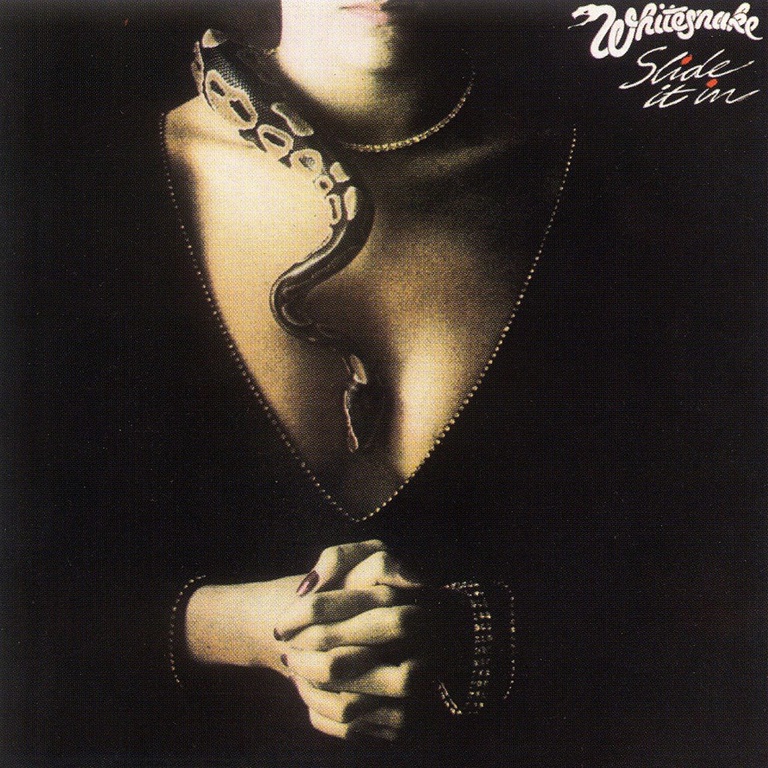
There are albums that can define a band, and then there are albums that can redefine one. Slide It In for me sits squarely in the latter category. Sure, 1987 is the record that turned Whitesnake into one of the biggest hard rock bands on the planet, but without Slide It In—or more specifically, without the remixed U.S. version of Slide It In—there probably isn’t a 1987 as we know it. This is the pivot. The moment David Coverdale looked west, embraced bigger production, sharper hooks and a more polished sound, and unknowingly laid the foundations for one of the defining hard rock albums of the decade.
It’s also David Coverdale at his most gloriously incorrigible.
If there was ever an album where Coverdale proved that every lyric could be interpreted as a double entendre—or three—it’s this one. The title alone leaves absolutely nothing to the imagination, and from there he spends the next forty-odd minutes wrapping innuendo inside blues swagger with the confidence of a man who knew exactly what he was doing. The genius was that he somehow made it sound classy. Ridiculous? Absolutely. But nobody sold a cheeky lyric with more conviction than Coverdale in 1984.
Of course, there are really two Slide It Ins.
The original UK release, with its different track listing and more understated mix, still felt very much like classic Whitesnake—the natural successor to Saints & Sinners and Come An’ Get It (my two favourites from their catalogue). It was blues-based, earthy and unmistakably British. I loved it personally.
The U.S. remix, however, changed everything.
Critics outside of the UK had labelled the original mix flat, and the American overhaul injected the record with a brighter, punchier, more modern production that suddenly placed Whitesnake shoulder-to-shoulder with the rising U.S. hard rock scene. It gave the band the sonic “voice” Coverdale knew he needed if Whitesnake were to crack America in a serious way.
Listening now, it’s impossible not to hear that roadmap to 1987.
The guitars bite harder. The rhythm section hits with more authority. The choruses leap from the speakers. It still carries enough blues DNA to satisfy longtime fans, but now there’s chrome around the edges. Conversely it was less subtle and lost a little of it’s Soul in return for Sparkle.
Ironically, this album also marks the beginning of the end for one era of Whitesnake—and, in many ways, the final chapter for Thin Lizzy.
During the subsequent tour the band was effectively rebuilt from the ground up. Micky Moody departed. Colin Hodgkinson was replaced by returning bassist Neil Murray. Mel Galley sadly injured ended his tenure. Jon Lord returned to Deep Purple for Perfect Strangers. Cozy Powell would soon be gone.
Most significantly, Coverdale landed John Sykes.
Kalodner had convinced Coverdale the band needed a genuine guitar hero to match his own charismatic frontman persona, and Sykes delivered exactly that. But while Whitesnake gained the final piece of the puzzle, Thin Lizzy effectively lost theirs. They never released another album after 1983’s Thunder and Lightning. The guitarist who would become such a defining force on 1987 arrived here, and rock history shifted accordingly.
It’s one of those rare moments where two bands’ destinies crossed in opposite directions.
Ironically, years later Coverdale would even revisit and re-record songs written with Micky Moody and Bernie Marsden —the guitarists many in America considered too bluesy and insufficiently “glam” for Whitesnake’s new direction. Yet Moody’s fingerprints remain all over this record, including a co-writing credit on the magnificent “Slow An’ Easy.”
And what a song that is.
For me it’s the perfect bridge between two worlds—the dirty, smoky blues-rock Whitesnake of the late ’70s and early ’80s, and the polished arena giant waiting just around the corner. It’s heavy without trying too hard, groove-laden, swaggering and effortlessly cool.
Elsewhere the quality rarely dips.
“Love Ain’t No Stranger” remains one of Coverdale’s greatest ever performances. Beginning as a heartfelt ballad before exploding into one of the band’s finest choruses, it’s timeless and still sends shivers down the spine.
“Guilty of Love” is criminally underrated, packed with hooks and that irresistible combination of melody and muscle that would soon become Whitesnake’s trademark.
“Standing in the Shadow” is another overlooked masterpiece, driven by an infectious groove and one of the album’s strongest vocal performances.
The title track “Slide It In”? I still hear AC/DC every single time I play it. The riff has that same stripped-back swagger, but Coverdale turns it into something uniquely Whitesnake through sheer charisma alone.
Then there’s “Gambler,” another classy slice of hard rock that often gets overshadowed but deserves far more recognition than it usually receives.
The 2019 US remaster that this re-release is taken from only reinforces how good these songs really are. The already superior U.S. remix gains greater clarity, punch and separation without sacrificing the warmth that made the record so enjoyable in the first place. The guitars have extra bite, Neil Murray’s bass comes alive, and the drums carry far more impact than many earlier CD editions.
It’s also worth noting that this was the last Whitesnake album to feature the band’s original snake logo—a fitting symbolic end to one chapter before the visual and musical reinvention that followed.
For me, this remains the strongest album of the “new” Whitesnake. If you remove the re-recorded Bernie Marsden classic “Here I Go Again” from 1987, I’d argue Slide It In is actually the more consistently satisfying record from start to finish. It still has one foot planted firmly in the blues, but the other is already stomping across the arenas of America.
It’s the missing link.
The sound of old Whitesnake evolving into the stadium-conquering beast they were destined to become.
And perhaps that’s why Slide It In has aged so well. It isn’t simply the end of one era or the beginning of another—it captures both at exactly the same moment.
9/10
Whitesnake’s classic albums Slide It In (1984), Whitesnake (1987), and Slip of the Tongue (1989) return to vinyl in their original U.S. 1-LP configurations. Alongside the wide release on standard black vinyl, exclusive color pressings